Imagine a permitting department within an organization needing to process a new application to install infrastructure within a city dwelling. A representative from the department researches city requirements, develops the submission package and then submits their permit application via email. At first glance, managing this seems straightforward, and most organizations would rely on a CRM to store data about the customer, permit package, communication history, and account details. But receiving approval for that permit involves far more than tracking a customer record.
Supporting documents must be reviewed, approvals completed, inspections scheduled, and compliance requirements satisfied across multiple departments. Suddenly, a single request spans multiple teams, systems, and isolated pockets of information.
The CRM is a critical piece of the operational puzzle, but it is only one piece.
This challenge isn't unique to permitting. Modern organizations rely on an expansive tech stack: CRM platforms, document repositories, reporting tools, and legacy business applications. Each system serves a valuable purpose, but they rarely talk to one another.
The problem today isn’t a lack of technology – it’s about ensuring those systems are efficiently connected to streamline the end-to-end process.
Think about all the hours wasted switching between applications just to figure out what happened, what needs to happen next, and who is responsible for each task. Managers struggle to gain visibility across siloed departments, and leadership teams are left with plenty of data but no real insight into the processes driving business outcomes. All the puzzle pieces exist, but no one can see the complete picture.
CRM platforms are essential because they centralize relationship data about customers. They manage interactions and track customer activity beautifully. They do exactly what they were designed to do… but customer information alone cannot complete a business process.
In our permitting example, a CRM tells you who the customer is, how much they’re account spend will be when billing begins but that’s all dependent upon when the permit gets approved. What it doesn’t tell you is what step the application is currently stuck in the review pipeline, which documents are missing, which internal approvals are pending, or what exact task needs to happen next.
That vital operational data lives elsewhere. Documents sit in a separate document management system, communications happen in email, and multiple teams are working in parallel to complete tasks they received via email. Inspections are logged in fieldwork platforms, and metrics are trapped in static reporting tools.
The real challenge isn't accessing customer data but rather connecting that data to the actual work being performed across the enterprise. This gap not only impacts our permitting example, but it also impacts every major business function from HR employee onboarding, procurement, finance, grants management, etc. Success depends entirely on how well these disconnected pieces work together.
This is where a Low-Code/No-Code Application Platform delivers its real value. Rather than attempting a costly, disruptive replacement of your existing systems, a low-code platform acts as an intelligent connective layer that unites them.
Using BizFlow M, organizations build an application tailored to their business. That application sits above existing systems and is designed around the process, not the software. A permitting application, for example, might include forms that pull customer information from the CRM, surface supporting documents, display approval status, and guide users through each step of the process. The underlying systems remain unchanged, but employees interact with a single application built specifically for the way the organization works.
The underlying systems continue doing what they do best. Customer records stay in the CRM, documents remain in their repositories, and operational data lives in its source systems. Instead of asking employees to move between applications to piece everything together, the unifying application gives them one place to manage the process from start to finish.
Instead of forcing employees to go on a digital hunt across five applications, organizations gain a complete view of the work. Everyone can see what work is occurring, who owns it, and where the process stands. The result isn't just better access to data. It's a connected workflow that reduces manual effort, improves visibility, and helps move business outcomes forward.
Platforms like BizFlow M are built specifically to bridge these systemic gaps. As a Low-Code/No-Code Application Platform, BizFlow M integrates everything from your core customer data and backend workflows across documents, approvals, and operational systems that drive daily business.
In a permitting scenario, BizFlow M connects CRM data directly to internal application reviews, document management, supervisor approvals, field inspections, and performance reporting. Permitters gain total visibility into the process rather than isolated data points. Managers spot bottlenecks and rebalance workloads in real time. Leadership gets a clear, unvarnished view of operational performance.
Because BizFlow M is highly configurable, organizations can easily adapt and extend their solutions as business requirements and compliance regulations evolve.
While connecting a CRM is often an organization’s first step, it is rarely the last. This unified approach is a blueprint for optimizing any complex business function.
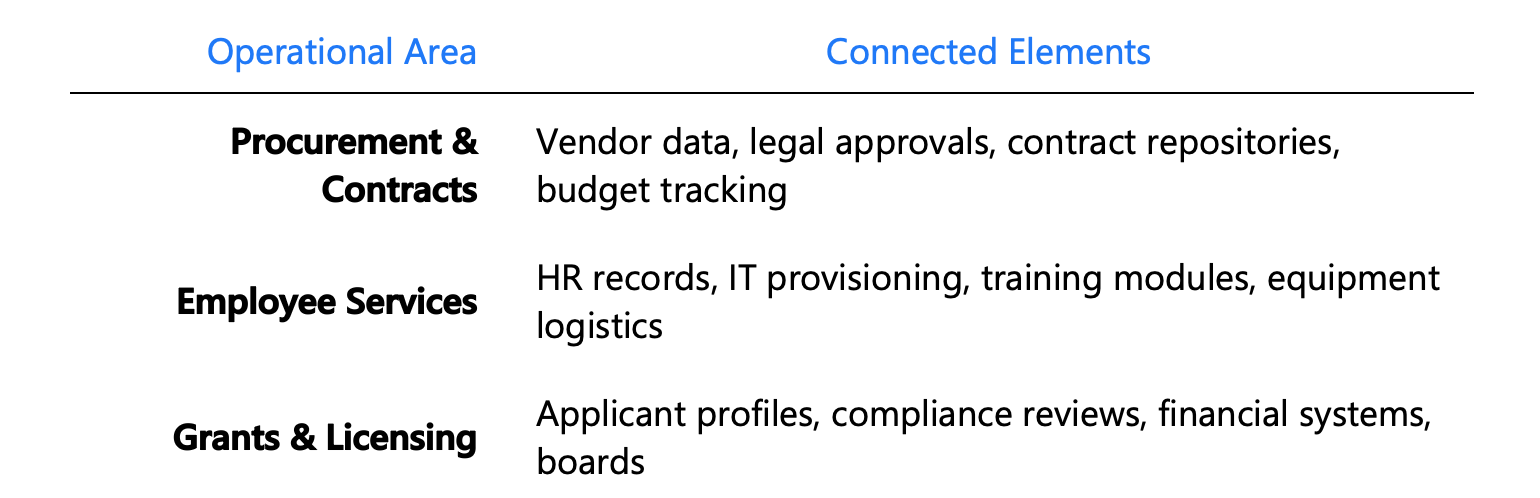
In every case, the objective remains identical: connect the people, processes, documents, data, and systems required to achieve a swift, successful outcome.
Organizations don't need another isolated software application to manage. They need a way to orchestrate the investments they have already to create a seamless, complete picture of how work gets done.
Organizations rarely lack the pieces. More often, they lack a clear view of the picture those pieces can create. The opportunity is connecting them into one agile, connected enterprise.